
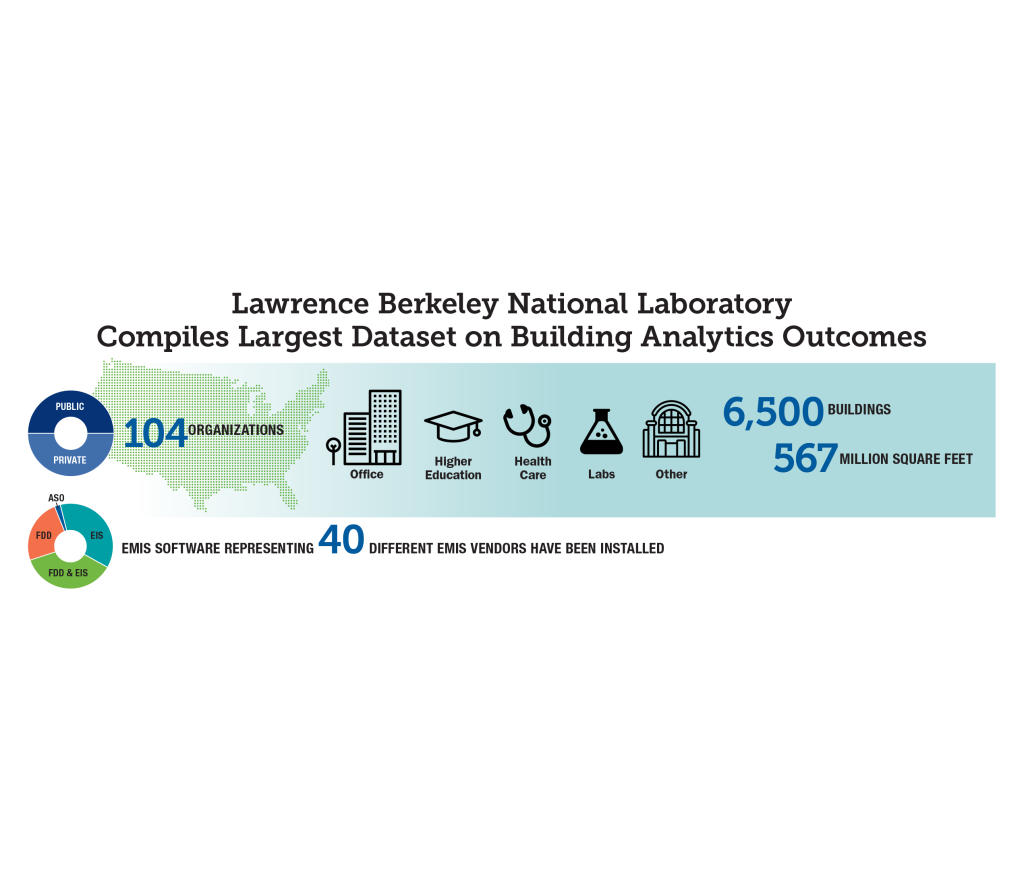
This case study features information and data gathered from over 100 commercial organizations that participated in the U.S. Department of Energy’s Smart Energy Analytics Campaign (the Campaign). The Campaign was managed by Lawrence Berkeley National Lab (LBNL) and ran from 2016-2020 to provide free technical assistance to organizations implementing energy management and information systems.
Project Information
Location
Multiple cities and states across the United States of America
Building Typology
Community, Education, Hospitality, Office, Retail (Shops), Commercial Offices, Health
Technology Installed / Proposed
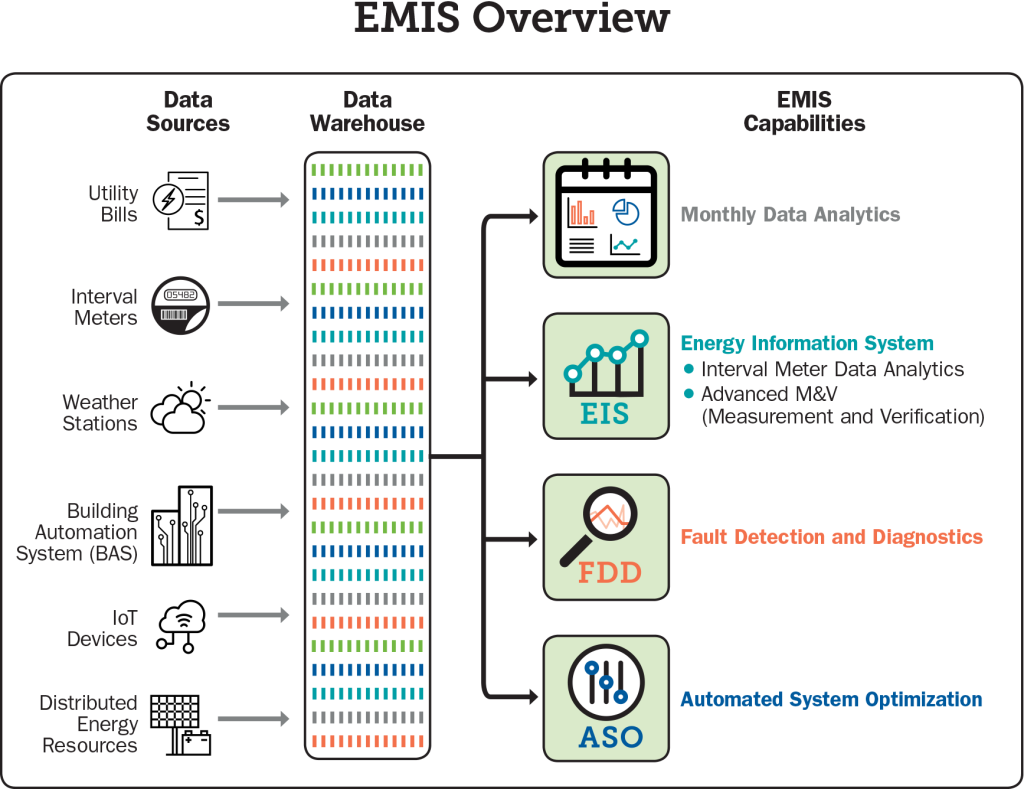
Organizations that participated in the Smart Energy Analytics Campaign installed some form of energy management and information system (EMIS) which includes: monthly utility data analytics, energy information systems (EIS), fault detection and diagnostics (FDD), or automated system optimization (ASO).
DATA AVAILABILITY
Key data from the Smart Energy Analytics Campaign is summarised in the final report titled Proving the Business Case for Building Analytics, which was published in October 2020. This report summarizes the findings from over 100 organizations that participated in the Campaign.
Status
Operational - Results Available
PROJECT AIM
The goal of the Campaign was to encourage the implementation of Energy Management and Information Systems (EMIS) and Monitoring-based Commissioning (MBCx) in commercial organizations across the United States. EMIS includes monthly utility data analytics, Energy Information Systems (EIS), Fault Detection and Diagnostics (FDD), or Automated System Optimization (ASO). Throughout the Campaign, Lawrence Berkeley National Lab provided technical assistance while also gathering data from participating organizations resulting in the largest dataset on EMIS cost and benefits. This data was then used to develop resources to help organizations throughout all aspects of installing EMIS and practicing MBCx. The resources support proving the business case, specifying an EMIS, implementing operational best practices and tracking savings.
BUSINESS PROPOSITION / MODEL
Participants in the Smart Energy Analytics Campaign followed various implementation strategies and therefore had a range of savings from their EMIS, as noted in the value proposition section. While energy and operational cost savings is quantified in the value proposition section, there are other benefits such as improvement in occupant comfort and streamlined maintenance practices.
VALUE PROPOSITION
By implementing an EMIS, Campaign participants were able to identify operational improvements such as improved HVAC scheduling and correction of simultaneous heating and cooling, while also unlocking the potential of automated analytics, which can identify issues that would not be possible with manual analysis. Organizations in the Campaign leveraged EMIS analytics to create heat maps, daily load profiles, and detection of sensor issues.
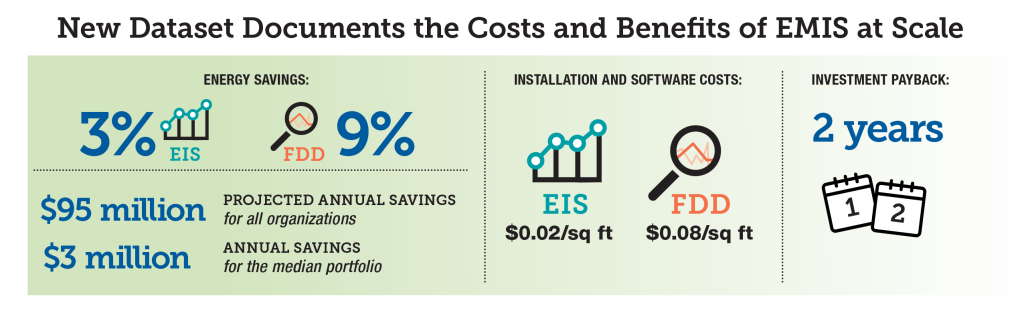
By the second year of installation, Campaign participants with energy information systems (EIS) achieved a median annual energy savings of 3% ($0.03/sq ft) and participants with fault detection and diagnostic tools (FDD) achieved a median savings of 9% ($0.24/sq ft). The Campaign also collected data on other benefits of installing EMIS such as improved occupant comfort and a shift from reactive to proactive maintenance practices.
Seventy-two organizations in the campaign that installed EIS or FDD reported cost information which equated to a median two-year simple payback period. This payback includes information from EMIS vendors that had different pricing models. For example, some vendors price per building while others price based on total floor area of the portfolio.
IMPACTS
The Campaign highlighted that there are many strategies for successfully implementing EMIS across different building types and industries. A wide range of EIS and FDD tools were deployed and enabled organizations to find energy savings. Successful organizations often started with a pilot project before deploying EMIS across all buildings. A pilot allows the organization to focus on a single building and work out issues with their process prior to scaling. Additionally, combining EMIS installation with existing building commissioning provides opportunities to increase the initial energy savings in a building.
LESSONS LEARNED
A major outcome of the Campaign was the consolidation of best practices and lessons learned based on the experience of over 100 organizations. Some of the major enablers were ensuring management buy-in, ensuring staff see the value of integrating the EMIS into existing processes, and intentionally implementing analytics to avoid data overload. The final Campaign report summarizes this information, and details on organizations with exemplary performance can be found on the Campaign’s Success Stories & Recognition page.
IMPLEMENTATION
Campaign participants included 104 commercial organizations across the United States, totalling 567 million square feet of gross floor area and more than 6,500 buildings (with office and higher education accounting for 80% of participants). With such a large range of organization types and building portfolio sizes, there were many different requirements for the EMIS. Some organizations had an in-house team that would implement and operate the EMIS, while others used a third-party service provider. Data integration and data quality was one of the most important aspects of EMIS installation and configuration. For example, organizations that had a data warehouse to provide a single location for all relevant data streams experienced a smoother implementation process.
ADDITIONAL INFORMATION
All resources and case studies developed as part of the Smart Energy Analytics Campaign can be found on the toolkit website.
For more information on the Case Study
Contact Person:
Nora Hart

Copyright Statement
Fraunhofer IEE agree that the case study information of ZUB Building can be shared under CC BY-NC-ND 4.0 license. This license allows others to download your works and share them with others as long as they credit you, but they can’t change them in any way or use them commercially.