
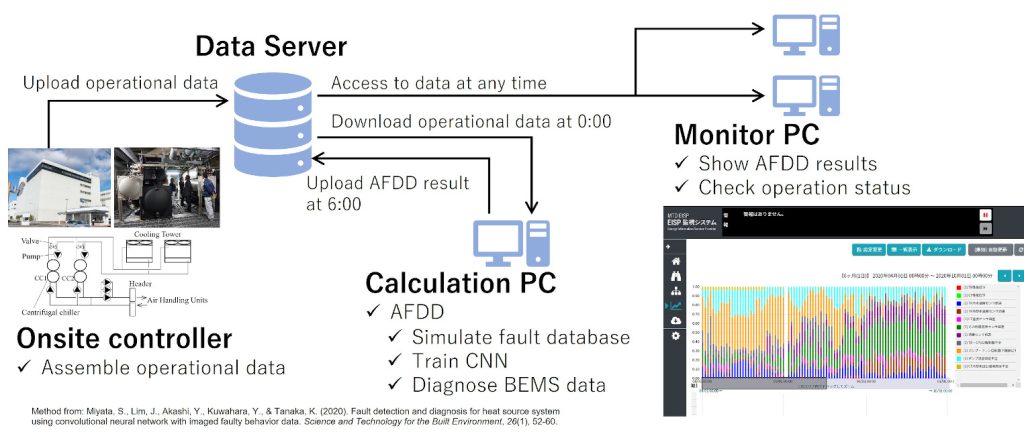
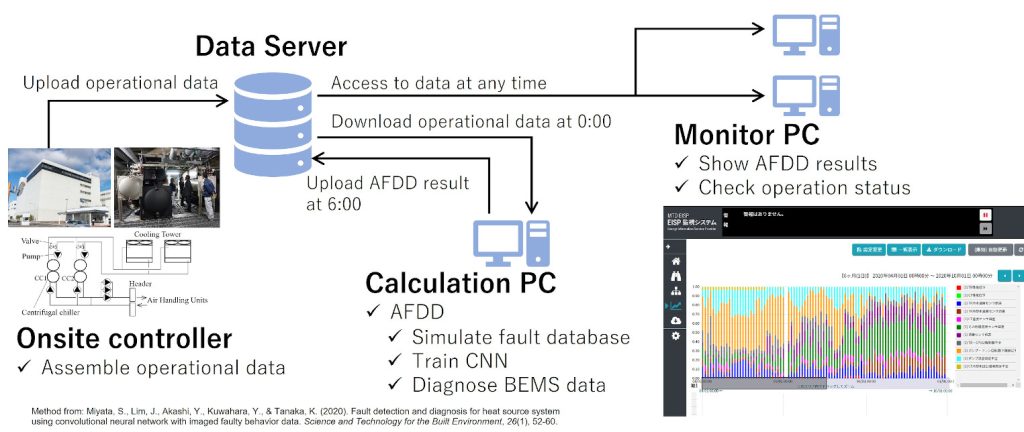
The target system is a cooling plant for air-conditioning in a factory building, which demands high cooling load throughout the year. The onsite operators have a lot of works except for the energy savings, therefore, automated fault detection and diagnosis (AFDD) methodology was developed and demonstrated it in real time. Operational data is diagnosed every day and each morning it is possible to confirm the AFDD result of the day before.
Project Information
Location
Sendai, Miyagi, Japan
Building Typology
Industrial Building
Technology Installed / Proposed
Automated fault detection and diagnosis (AFDD) using convolutional neural network (CNN).
DATA AVAILABILITY
Information such as system configuration, equipment specifications and equipment performance curves, as well as operating data at 15-minute intervals, such as flow rate, temperature, power and frequency (pumps), can be shared within IEA-EBC Annex 81 members only.
Status
Operational - Results Available
PROJECT AIM
Although the current rule–based AFDD is useful for abnormal detection, there are still difficulties to locate root causes of the faults as it requires expert knowledge to define thresholds for faults that should be varied from a system to another. Therefore, we proposed a novel AFDD method using simulated faulty data and CNN to diagnose real data. Firstly, to achieve high diagnosis performance, an original simulation program was developed to obtain faulty behaviour data with high quality. Then, CNN was trained based on the faulty data. Finally, the trained CNN diagnosed the real operational data. The aim of this case study is to demonstrate the effectiveness of the proposed AFDD method in the real world.
BUSINESS PROPOSITION / MODEL
This project has not studied the business model yet. However, it could be offered as software as a service (SaaS) or as a service tied to energy services.
VALUE PROPOSITION
In this case study, a 3% annual improvement in energy efficiency was achieved through a simple change in setpoints. Since the proposed AFDD method makes it easy to identify the root causes of faults, we were able to smoothly change the setpoints by showing the energy-saving effects of the simulation to the onsite operators.
IMPACTS
It is generally impossible to estimate the effect of AFDD because the state of a system can only be observed when it is diagnosed. Therefore, AFDD is not effective for systems without faults, but in this case, a simple change in the setpoint resulted in a 3% improvement in operation. Scalability/transferability are follow-up tasks for the demonstrated AFDD method, especially coding the system simulation for faulty data generation.
LESSONS LEARNED
Modelling and simulation:
Coding system simulation requires very high cost; however, it is not easy to pay it back only by AFDD. Therefore, the developed simulation should be utilised not only for AFDD, but also for other technologies such as optimal operation and optimal design for the renovation.
Model transferability/ Data specification:
We tried to apply this AFDD system to other systems which have less measured data. However, it was difficult due to the low resolution of the data. Therefore, data requirements should be discussed from the design phase of the system, and we need to appeal the effectiveness of the AFDD system to the building owners.
Industry acceptance:
In this case study, we explained the result of AFDD and expected improvement using the simulation result. The onsite operators welcomed the result and were cooperative in fixing the faults.
Computational requirements and complexity:
Automatic data acquisition from the onsite controller required some cost. The most difficult challenge is the stable operation of the AFDD system. The target system sometimes stops operation for maintenance; therefore, it is necessary to connect information from the field to the AFDD system. In addition, the calculation server was set in the university, where power outages for inspections occur, so it is necessary to devise ways to ensure that operations are not interrupted.
OS updates on the compute server often occurred unexpectedly, causing computation to stop. The settings of OS updates were changed to cope with this problem.
IMPLEMENTATION
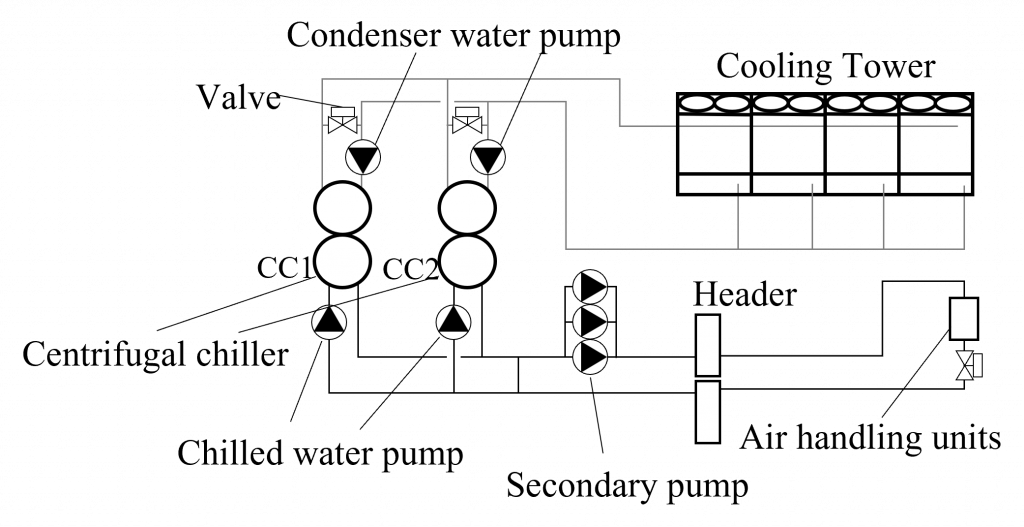
The target building is a factory with total floor area of 27,700 m². The target cooling plant is described below.
The proposed AFDD methodology consists of three steps: i) system simulation for faulty data generation; ii) CNN training using the faulty data; and iii) the application of AFDD by the trained CNN on real data.
In the real time implementation, the measured data are collected and stored at the site location. The data is downloaded daily on a local computer via cellular network and the AFDD software is run; the results obtained are uploaded to a server and can be monitored through a browser. In order to apply this AFDD system, the operational data (e.g., temperature, flow rate, power consumption, etc.) of each equipment is preferably recorded in time steps of 15 minutes or less. If the data resolution is not sufficient, it will become difficult to distinguish similar faults such as sensor errors and inappropriate set points.
ADDITIONAL INFORMATION
For more information on the Case Study
Contact Person:
Dr Shohei Miyata

Copyright Statement
Fraunhofer IEE agree that the case study information of ZUB Building can be shared under CC BY-NC-ND 4.0 license. This license allows others to download your works and share them with others as long as they credit you, but they can’t change them in any way or use them commercially.