
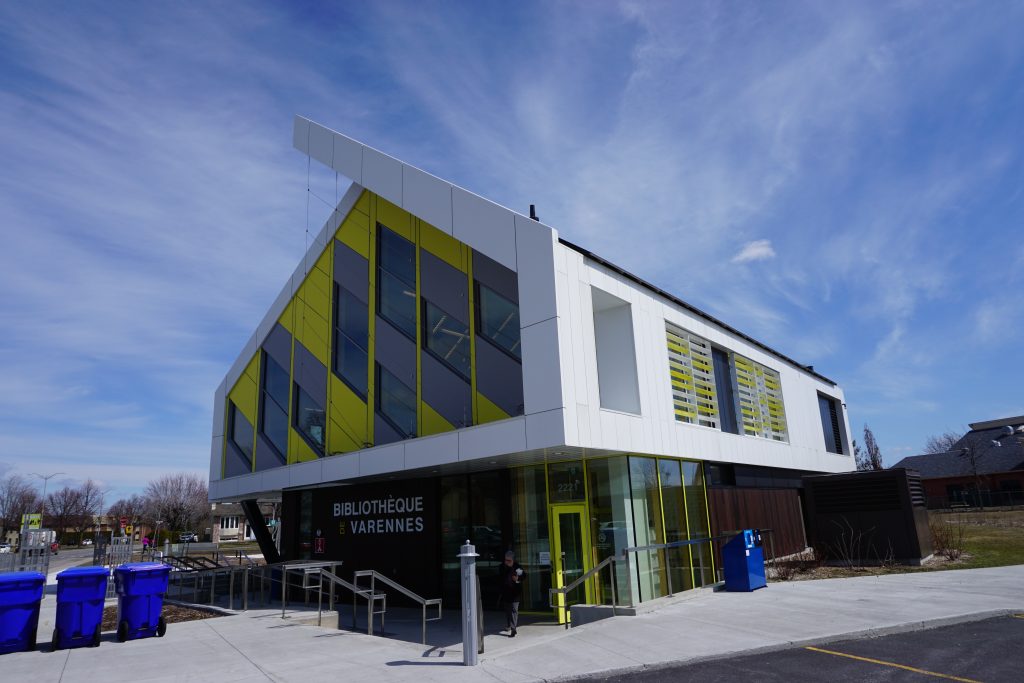
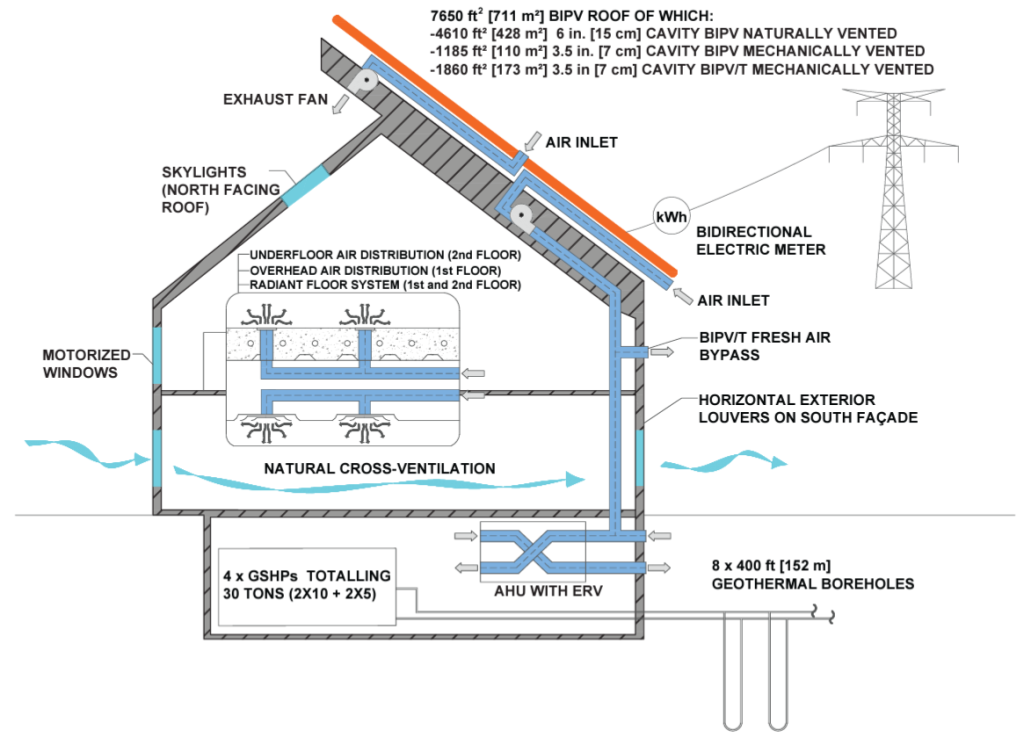
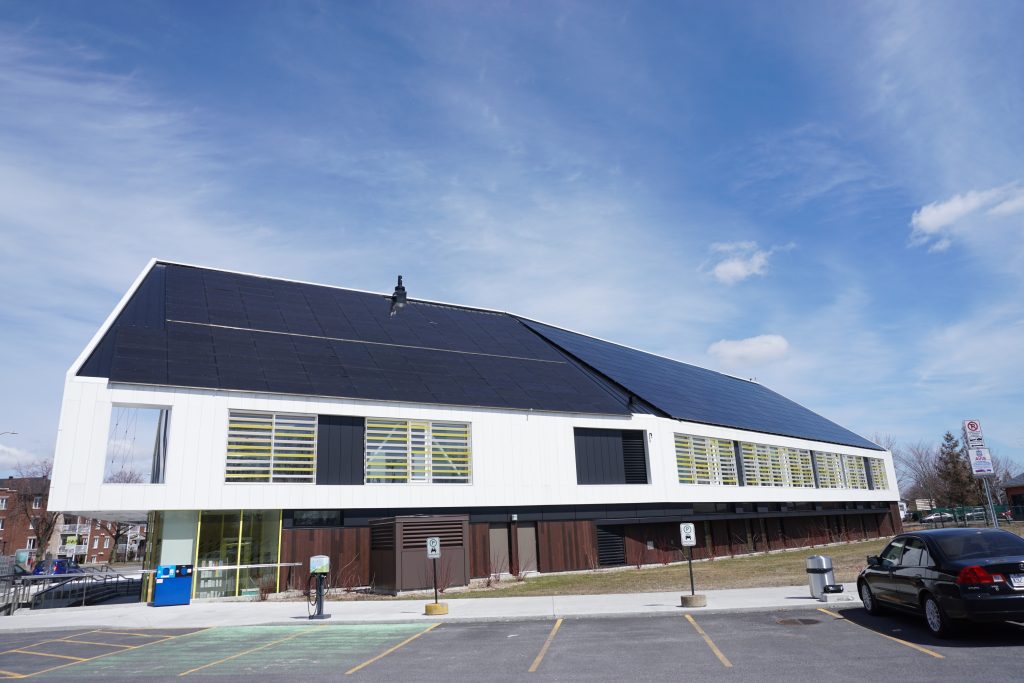
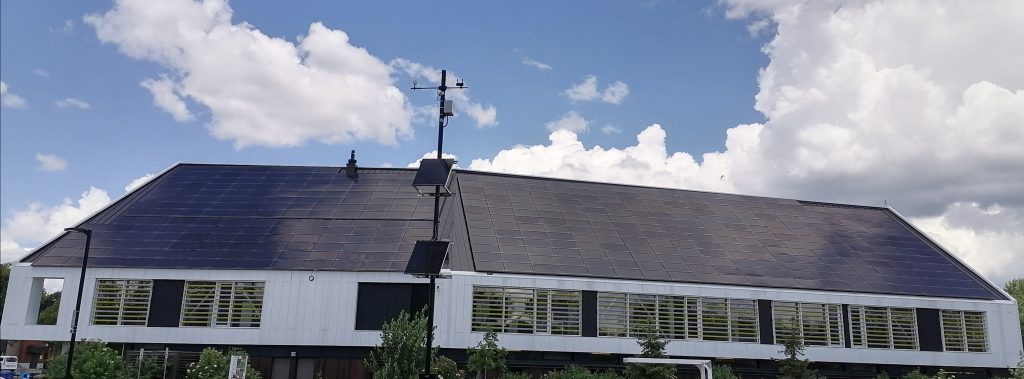
The Varennes Net-Zero Energy Library is a 2,000 m2 municipal library building located in the town of Varennes, about 40 km away from Montréal. This library, developed through an initiative of the municipality of Varennes with the collaboration of CanmetENERGY (Natural Resources Canada) and Concordia University, was designed through an integrated design process (“design charrette”) that brought together a strong team of architecture and engineering professionals from the Montréal region. The building was inaugurated in 2014. Technologies integrated into the design of the building include ground-source heat pumps (GSHP), hydronic radiant slab, electric vehicle charging stations, motorised windows for natural cooling, horizontal exterior louvers on south façade for daylight control. One of the key technologies featured is a 110 kWe building integrated photovoltaic (BIPV) system; 1/6 of the roof area also works as a building integrated photovoltaic thermal (BIPV/T) system that preheats the ventilation air. These systems, along with energy efficiency measures and a design made to optimise solar energy utilisation, has led to a near net-zero energy performance.
Project Information
Location
Montréal, Canada
Building Typology
Library
Technology Installed / Proposed
Model predictive control (MPC) for preheating/precooling the building to reduce energy consumption during peak demand periods and enhance energy flexibility.
DATA AVAILABILITY
Limited dataset available online.
Status
Operational - Results Available
PROJECT AIM
Although the library is a net-zero energy building (NetZEB), the focus is also shifted to the interactions between renewable production, energy storage, self-consumption and grid needs. This case study demonstrates that through a better integration of the different building subsystems, system components would perform efficiently and can be sized smaller, reducing investment and operation costs. Another objective of this project was to transfer acquired knowledge to the building design sector, convince other municipalities to adopt the integrated design process method, reduce the perception of high-performance buildings having a higher life-cycle cost, and to educate and showcase to the public the library’s various net-zero energy enabling technologies (particularly their integration).
BUSINESS PROPOSITION / MODEL
The Varennes Library was conceived as a demonstration project to showcase the potential of energy-efficient technologies, on-site renewables and data analytics to (a) achieve a net-zero energy performance, and (b) improve the interaction between the building and the grid and the energy flexibility of the building.
VALUE PROPOSITION
The design of the library required the collaboration of many specialists such as architects, engineers, researchers of various disciplines due to the complexity and involvement of different types of systems, which substantially reduced the energy demand of the building. One of the main benefits of this design was combining all these different technologies in one integrated system.
A 95% energy use intensity (EUI) reduction over the national institutional average was achieved. Further improvements are still possible to reduce the overall energy consumption. One of the proposed strategies is model predictive control (MPC) on the radiant slab. By using a model of the building and the weather forecast, the control strategy will determine the heating/cooling profiles which can minimise the energy consumption by anticipating future loads such as occupancy or solar gains. A pilot program of this strategy was implemented during December 2021 by using the weather forecast and predetermined setpoint profiles for different types of days, which showed some promising results. Similar strategies can also be implemented for daylight/lighting control and control of the BIPV/T system.
IMPACTS
Initially, the finalised building energy use intensity (EUI) was estimated at 85 kWh/m2y. The first year of operation (June 1st, 2016, to May 31st, 2017) the actual EUI was 78.1 kWh/m2y and has since been reduced to about 70.0 kWh/m2y. Some possible explanations on the consumption reduction may be higher occupancy during the first year and replacing the luminaires with LED types. When considering the energy production from the renewables, the net EUI is around 4.60-14.5 kWh/m2y.
The roof mounted BIPV/T can produce 220 kWh of solar heat for a typical cold, sunny day. On average, 6,835 kWh have been harvested per heating season (November to April).
The building’s heating and cooling is supplied from four ground-source heat-pumps connected to eight 152 m deep boreholes with a cooling capacity of 106 kW (30 tons). Preliminary heat interactions with the ground revealed a yearly imbalance in the range of -65,000 kWh, which signifies that the ground is heating over time, i.e. the building is cooling dominated.
This project can give valuable guidelines for future implementation of similar buildings. The basic concepts and design can be easily transferred to other types of building and different locations.
LESSONS LEARNED
Operational strategies:
Excess electricity is sold to the grid and compensated for up to 50 kW as per the agreement with the utility provider. As there are no batteries installed, the library is motivated to consume its electricity as much as possible. However, it was calculated that 642 kWh of energy was exported pro gratis for a period of one year. The addition of batteries and/or the connection to other buildings within the neighbourhood could facilitate in the development of a smart-distributed network and better load management during peak consumption hours.
The air flow rate within the BIPV/T system is set according to simple rule-based control strategy to avoid overheating. However, in many cases this results in non-optimal operation and lower efficiency. Model-based control can improve the performance of such systems.
Ten 10 kW inverters are used to convert the current from the BIPV system. The inverters were slightly undersized with the aim to achieve higher yields during average days. After observing a continuous underproduction, it was discovered that two inverters were not functioning and a third one was functioning erratically. Poorly functioning inverters have since been replaced. Possible explanations include that the inverters were breaking down due to a combination of the following issues: a much larger production than their rated 10 kW caused overloading; the maximum power point tracker (MPPT) had failed; the PV strings were not wired correctly; and/or the inverter settings were incorrect and led to failures. A dedicated controller was installed in February 2017 to monitor the individual inverters.
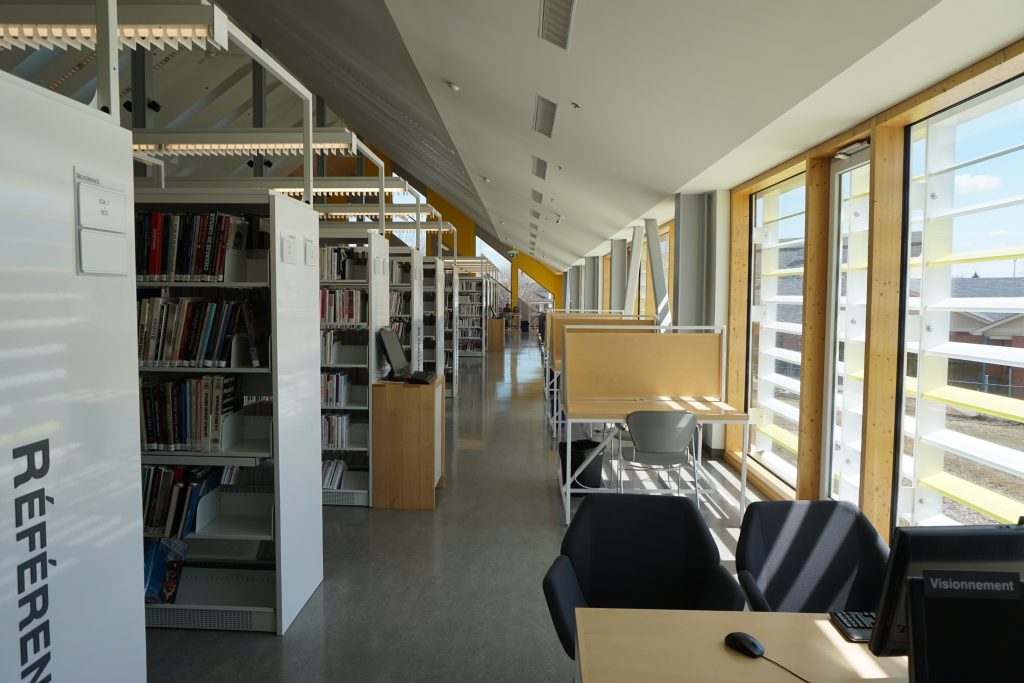
When the library was first opened, the lighting was set to a minimum of 800 lux (80 foot-candles, fc) everywhere. Since then, lighting was reduced following guidelines by the Illuminating Engineering Society (IES). However, when lighting was reduced, occupants complained that it was too dim, possibly because of the strong contrast between the daylit areas and the book stacks.
Industry acceptance:
Some of the early challenges for this project came from convincing the different professional domains that the design will perform through examples.
IMPLEMENTATION
The Varennes Library represents an important case study, given the combination of several features. It is characterised by an on-site renewable energy generation with heat recovery for fresh air pre-heat, thus linked to an HVAC system. It was built to enhance passive solar design: window selection and sizing, concrete slab thermal buffer and overall geometry considerations. Moreover, it is characterised by demand-driven ventilation, in conjunction with underfloor displacement ventilation and the possibility for natural cross-ventilation. It presents radiant slab-based heating and cooling, linked to ground-source heat pumps. The building is operated on a schedule which minimises occupancy-related uncertainties and is characterised by proactive and receptive building operators. The building acts as its own nano-grid.
ADDITIONAL INFORMATION
V. Dermardiros, A.K. Athienitis, S. Bucking. (2019). Energy performance, comfort, and lessons learned from an institutional building designed for net zero energy. ASHRAE Transactions, 125, 682-695.
For more information on the Case Study
Contact Person:
Prof. Andreas K. Athienitis