
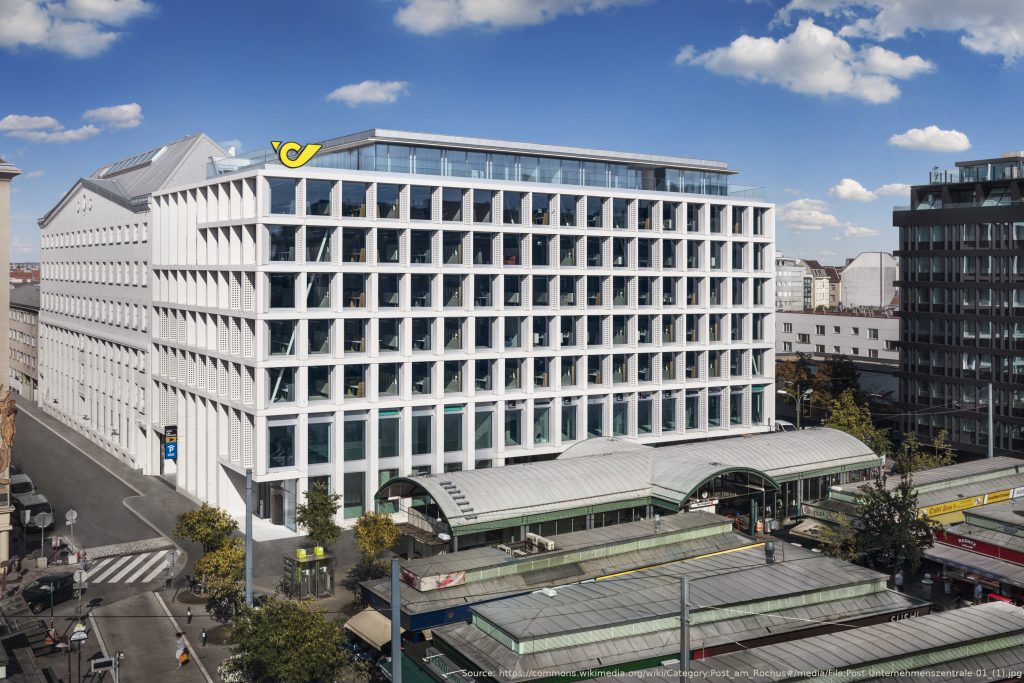
Post am Rochus is a large multifunctional building (47,300 m² gross floor area) combining office and retail space. It was designed to the Passive House Standard and was completed in 2017 for the Österreichische Post AG. A 5000 m² of retail space is located at the ground floor, first floor and lower ground floor of the building, while the upper floors house the Austrian Post headquarter offices. The building has a complex energy supply system. The project received a number of 1st Prize awards.
Project Information
Location
Vienna, Austria
Building Typology
Office and Retail Building
Technology Installed / Proposed
Building control strategies, building sensing and automation.
DATA AVAILABILITY
TBC
Status
Operational - Results Available
PROJECT AIM
The aim of the building owner was to obtain a modern comfortable building with very high standards regarding sustainability and energy efficiency, not only in the operational phase but also during the execution phase and commissioning. Therefore, the goal was to shorten the commissioning phase by integrating a very detailed study and optimisation of control strategies of the HVAC systems along with the involved planning, construction and operational project team. Within the project the building was scientifically monitored and the following technologies in the HVAC system were used:
- Three highly efficient compression chillers with 1 MW capacity each.
- The option for heat recovery during cooling season (reheat-coil during dehumidification).
- The utilisation of a 320 m³ sprinkler water basin as cold temperature storage for free-cooling (via recoolers).
- Concrete core activation for cooling.
- The major air handling units are equipped with latent and sensible heat recovery (enthalpy rotor with bypass).
The heating energy for concrete core activation and fan coils is supplied by the local district heating grid. Service hot water is prepared decentralised by electric heaters.
BUSINESS PROPOSITION / MODEL
A dynamic up-to-date baseline over the whole building lifecycle can be used for automatic fault- and inefficiency-detection, which can further improve the buildings’ quality and ensure to meet the energy and comfort targets that the owner paid for in the first place. Furthermore, ensuring energy-optimised operation and avoiding suboptimal operation due to faulty controls energy and cost savings are possible.
VALUE PROPOSITION
Once the control strategies were finalised by the control engineers, certain parts of their implementation in the building automation software were tested using the “controller-in-the-loop” approach. This allowed to test the control strategies on the actual controller hardware to be implemented in the building. Functionality checks were performed for all operational modes prior to their implementation in the building and thus independently of the actual weather during commissioning, which is an important benefit as cooling systems can hardly be fully tested in heating season. This approach reduced commissioning time and errors, since bugs could be found before the soft- and hardware were finally implemented.
IMPACTS
It was successfully proven that there is still a long way to go when it comes to establishing integral planning practices and “educated commissioning” procedures in highly complex nearly Zero Energy Buildings (nZEB). Extensive usage of dynamic thermal simulations into the building automation and control domain should become common practice, as it really plays an enabling role for the successful realisation of high quality and comfortable nZEB.
In detail, the following impacts on time, costs and energy aspects were reached during the different project phases:
- Time and financial savings by shortening the commissioning phase and reducing time-intensive bug fixing at later stages.
- Energy savings by ensuring energy-optimised operation and avoiding suboptimal operation due to faulty controls.
LESSONS LEARNED
Technology deployment:
Based on this experience, a successful commissioning phase is supported by the following factors:
- Functional quality management on component level.
- Correct functionality of the whole hydraulic system including extensive hydraulic balancing.
- Provision of a clear documentation for the commissioning phase of all major components (building automation, energy efficiency/performance targets, set points, etc.).
- Definition of suitable overall control strategies and operational modes for the whole system.
In order to guarantee an efficient operation of the system, it is further recommended to install a quality management system for the trial operation phase. Therefore, major operational modes and procedural steps to be tested must be clearly defined together with the control engineers.
Modelling and simulation:
The project highlighted the need for methods to improve the modelling time of HVAC systems.
One barrier encountered is the lack of information in the early planning phases during execution, as some components will be fixed on quite short notice. This results in a high number of assumptions to be made, which might affect the quality and reliability of the obtained results. The time needed to set up such complex models including bug-fixing, plausibility checks and adequate visualisation of the results might be problematic, as decisions are often time-critical and of course time means costs which is always a problem in building construction processes.
Data management:
Nevertheless, the digitalisation of relevant data is a prerequisite that goes in line with the rapid development of the building information modelling (BIM) industry. This would also overcome and reduce the problem of data loss that typically happens at all interfaces, for example:
- planning – construction – operation,
but also between different disciplines, for example:
- HVAC planner – control engineer or,
- Building automation – facility management.
Governance, compliance and legal oversight:
From a legal perspective, it must be clearly regulated how to deal with simulation results in the context of construction projects, as some information or in fact changes to the functional technical description may occur. Another legal issue is the operators’ contract that often contains “energy saving targets”. These are mostly measured in relative savings compared to previous period over the first 3-5 years of operation, which is obviously not the best solution.
The usage of the design values as target might not always be feasible, as assumptions might change during the planning and construction phase. This requires a recalibration of the design models with as-built values that should be validated by monitoring data.
IMPLEMENTATION
Within the implementation, white box thermal building simulations were carried out (due to unavailability of monitored data) and complemented with other methods such as the “controller in the loop”. The latter approach was based on a white box model of a ventilation system that was coupled with a real controller in order to test the controller programming before its implementation in the building. Simulation outputs were analysed to check that the control system was behaving as expected, and abnormalities were documented and communicated to the control engineer for further investigation.
Nine different operational modes have been identified. Cost-optimised control strategies have been defined for each mode by using parameter variations of e.g., set points, hysteresis, time schedules, cross-dependency curves (e.g., power cascades), etc. The aim was to describe all modes in a way that the control engineers and the operators/facility managers could obtain a practical guidance for programming, operation and bug-fixing. Furthermore, it was ensured that all involved parties can refer to the same data basis, i.e. a “functional manual” including controller set points, times schedules, etc.
TRNSYS 17.02 software was chosen for building energy performance simulation (BEPS), as it was used by all simulation parties involved. Due to the high complexity of the simulation tasks and for unhindered workflows in the different offices, the overall HVAC model was split into three independently functioning decoupled sub-models (the following investigations are based on the second part model):
- Multizone building model: Optimisation of the envelope, control strategy development of concrete core activation, calculation of heating and cooling loads (input for thermal system).
- Thermal (cooling) system: Control strategy development and optimization of all operational modes.
- Ventilation system: Control strategy development and optimization for various operational modes of the air handling units.
The results of the sub-models were validated individually and taken as input for the thermal model. This model used the load curves for high temperature cooling (concrete core activation) and low temperature cooling (fan- and cooling coils) that were calculated in the building and ventilation model as an input. The load curves of the supermarket and server rooms were estimated according to standards (SIA20242).
ADDITIONAL INFORMATION
P. Horn, S. Hauer, A. Bres, K. Eder, I. Lindmeier, A. Frey. (2019). Educated commissioning and operation of a complex nearly zero energy office building with the help of dynamic thermal HVAC-simulations – a best practice report from the Austrian postal service headquarter Post am Rochus. Journal of Physics: Conference Series, Vol. 1343. No. 1, 012137.
For more information on the Case Study
Contact Person:
Gundula Weber

Copyright Statement
Fraunhofer IEE agree that the case study information of ZUB Building can be shared under CC BY-NC-ND 4.0 license. This license allows others to download your works and share them with others as long as they credit you, but they can’t change them in any way or use them commercially.