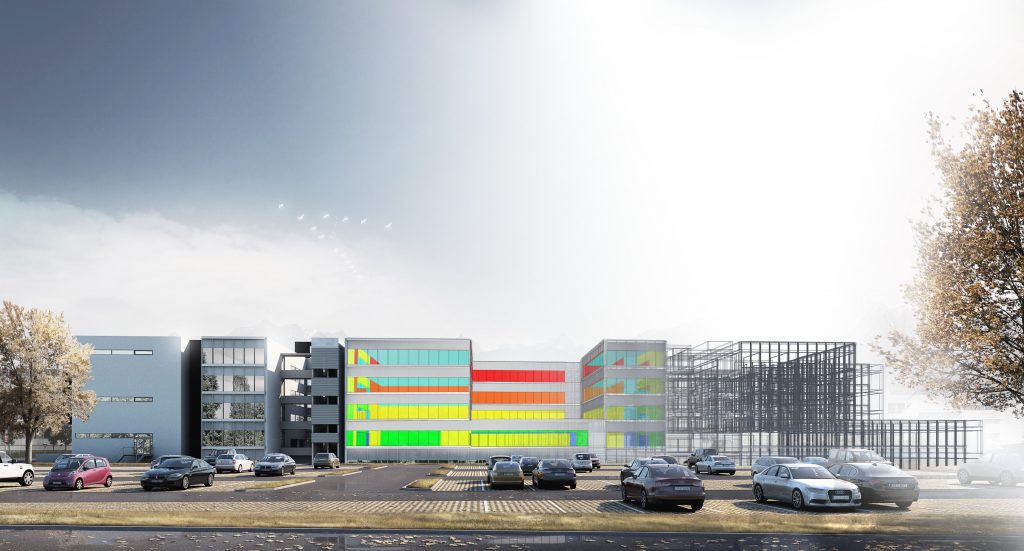
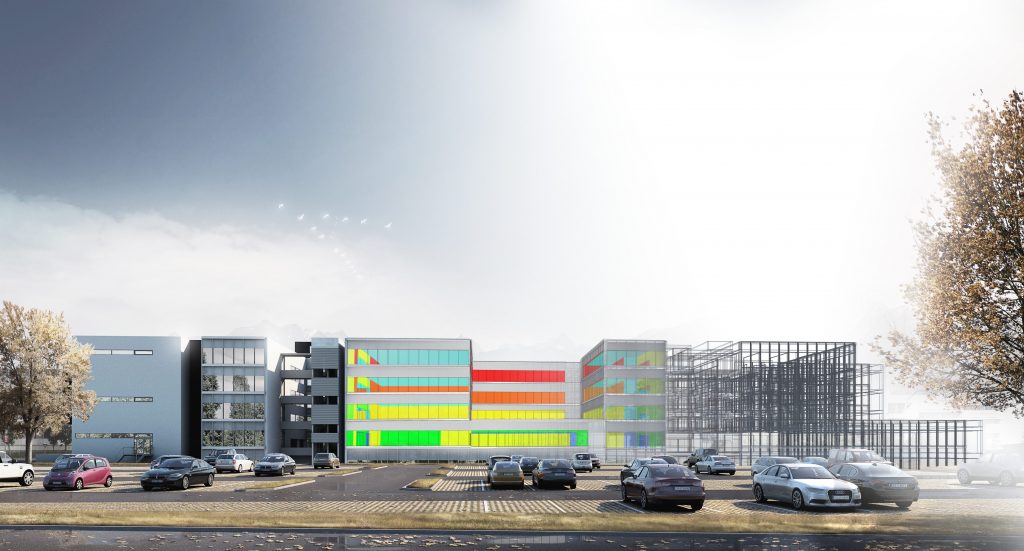
The building is a research and development building of Infineon Technologies Austria AG, world-leading provider of semiconductor solutions. It is a new building completed in 2020 with a total building area of 20,000 m2 on five levels. It includes office areas and meeting rooms for around 600 employees as well as 5,500 m² of laboratory space.
Project Information
Location
Villach, Austria
Building Typology
Office and Laboratory Building
Technology Installed / Proposed
The primary purpose of this intervention was to test a building-tracking system based on the IDA ICE simulation software. This building-tracking system (currently under development) is planned to run a digital twin of the building and its services in real time. Within the EU Project Arrowhead Tools, the building-tracking system was developed and tested in the laboratory. The selected parts of the Infineon building are used to demonstrate the system in an existing setting.
DATA AVAILABILITY
Data are confidential.
Status
Testing/Commissioning [development of further functionalities is still ongoing]
PROJECT AIM
The goal of the project is to create a real-time digital twin and continuously calibrate it during operation to reflect the actual state of the building. With this information, the energy consumption of the building services should be reduced and user comfort enhanced. Within the EU project Arrowhead Tools, the IDA ICE building and system simulation tool was extended to include real-time operation and coupling of the simulation program with real-time sensor data from the building, such as weather data, status of shading, windows and doors.
The first development and implementation step that was completed within the Arrowhead Tools project was the implementation of the real-time digital twin and an approach to force the model into the state of the real building (building tracking) in selected areas of the building (summer 2022). The second step, which is not finished yet and subject to further projects, is to generate optimised control settings and implement it in the building.
BUSINESS PROPOSITION / MODEL
The goal in the future would be to offer a building-tracking and building-optimisation service. The simulation models that are often set up during the planning phase could be used for optimisation purposes throughout the lifetime of a building in order to reduce energy consumption, detect faulty systems, increase user comfort and adapt the control systems to changed user behaviour or changed usage of the building.
VALUE PROPOSITION
As the final development stage of the digital twin has not yet been reached, the value of the use case is currently still at a research stage. Energy savings of 10-30 % are expected in the future and increased user comfort.
IMPACTS
The development step taken to implement a real-time simulation (digital twin) of a building is a large step forward towards automated optimisation of the building performance and closing the performance gap between planning stage and real building performance. However, the next step to implement automated optimisation still needs to be developed within further projects.
LESSONS LEARNED
As the building-tracking system is still under development, there are no final results and lessons learned yet. One of the development goals is to realise a reliable real-time simulation model of the building while using as little measured data as possible from the building automation system.
Data quality:
Data quality and data filtering are important issues to ensure smooth operation of the real-time simulation.
Modelling and simulation:
Several typical problems during the installation of building services occurred such as hydraulic errors, or errors in the control logic. A lot of those problems could be detected automatically with the fully operational digital twin.
IMPLEMENTATION
Within the EU project Arrowhead Tools, some 400 data points were installed to be used for building automation. A lot of the data points were included in addition to what is necessary for building automation for research purposes (e.g., validation of the simulation model and verification of building tracking accuracy). All sensors were included in the building automation system (BAS) and hence coupled with the simulation software – the building tracking system – in real time. The building and system simulation has been shown to run in real time using measured data from the building as inputs. It is continuously forced into the state of the physical twin using the building tracker developed within the project. To limit the necessary efforts, the digital twin has been limited to a few office and meeting rooms as well as a laboratory space. The focus is on the energy consumption for heating and cooling as well as the user comfort (e.g., air temperature, operative temperature, relative humidity and CO2 levels). The digital twin is an open-source white-box model of the building and its services.
This stage of the project was part of the EU Project Arrowhead Tools. In a next step, the real-time model could be used for various purposes such as automated fault detection or for automated optimisation of the building services. Another possible application is the visualisation (3D building model) not only of measured variables but also of simulated (so called virtual) sensors. With virtual sensing it is possible to “measure” key indicators which are expensive to measure or even harmful. This could include thermal comfort parameters such as the operative temperature in a room (instead of the air temperature), the spatial air velocity in a room, the heat flux through walls or the air infiltration rate.
For optimisation of the building services, optimised control settings would have to be sent back from the building tracker to theBAS. This functionality has been demonstrated on a laboratory level but so far not implemented in the demonstration building.
ADDITIONAL INFORMATION
For more information on the Case Study
Contact Person:
Dagmar Jähnig
Copyright Statement
Fraunhofer IEE agree that the case study information of ZUB Building can be shared under CC BY-NC-ND 4.0 license. This license allows others to download your works and share them with others as long as they credit you, but they can’t change them in any way or use them commercially.