
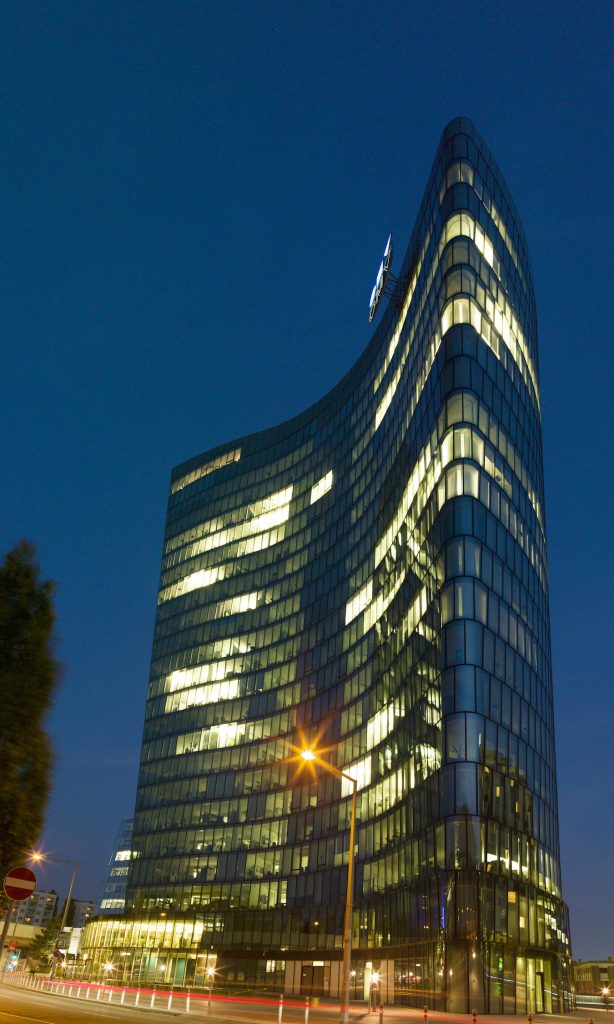
The OMV headquarter is an existing building located in Viertel Zwei in Vienna (Austria). It consists of two wings – an 80-meter-high tower (the so-called “Hoch Zwei”) and a lower rise cuboidal volume (known as “Plus Zwei”) linked by a glass bridge. The head office currently consists of open space offices both in the Hoch Zwei and Plus Zwei buildings, while the Plus Zwei building also houses the employee restaurant, the occupational health centre, the post office and the copy centre.
Project Information
Location
Vienna, Austria
Building Typology
Office Building
Technology Installed / Proposed
The primary purpose of this intervention was to test a building-tracking system based on the IDA ICE simulation software. This building-tracking system (currently under development) is planned to run a digital twin of the building and its services in real time. Within the running Austrian National Project Digitaler Zwilling (Digital Twin), the building-tracking system is developed and tested in the laboratory. The OMV building is used to demonstrate the system in an existing setting.
DATA AVAILABILITY
Data are confidential
Status
Under development, testing/commissioning (project end: beginning of 2023)
PROJECT AIM
The goal is to create a real-time digital twin of the cooling system (for the high-rise building Hoch Zwei) and the ventilation system and heating and cooling (for one selected level of the high-rise building), which are forced into the state of the real building (building tracking) during operation.
BUSINESS PROPOSITION / MODEL
The goal in the future would be to offer a building tracking and building optimisation service. The simulation models that are often set up during the planning phase could be used for optimisation purposes throughout the lifetime of a building in order to reduce energy consumption, detect faulty systems, increase user comfort and adapt the control systems to changed user behaviour or changed usage of the building.
VALUE PROPOSITION
As the final development stage of the digital twin has not yet been reached, the value of the use case is currently still at a research stage. Energy savings of 10-30 % are expected in the future as well as increased user comfort.
IMPACTS
The development step taken to implement a real-time simulation (digital twin) of a building is a large step forward towards automated optimisation of the building performance and closing the performance gap between planning stage and real building performance. However, the next step to implement automated optimisation still needs to be developed within further projects.
LESSONS LEARNED
As the building-tracking system is still under development, there are no final results and lessons learned yet. One of the development goals is to realise a reliable real-time simulation model of the building while using as little measured data as possible from the building automation system.
Data quality:
Data quality and data filtering are important issues in order to ensure the smooth operation of the real-time simulation.
Modelling and simulation:
Several typical problems during the installation of building services occurred such as hydraulic errors, or errors in the control logic. Several of those problems could be detected automatically with the fully operational digital twin.
IMPLEMENTATION
The existing building was equipped with several sensors and energy meters. Within the project, these sensors (included in the building automation system) were connected to a simulation model running on a cloud server. Work is still ongoing to calibrate the simulation models for the building, ventilation and heating and cooling supply systems.
On a laboratory level, sending data from the building tracker back to the building automation system (BAS) has been demonstrated. In the next step (and this is planned to be the topic of follow-up projects), the real-time model could be used for various purposes such as automated fault detection or for automated optimisation of the building services. Another possible application is the visualisation (3D building model) not only of measured parameters but also of simulated (so-called virtual) sensors. With virtual sensing, it is possible to “measure” key indicators which are expensive to measure or even harmful. This could for example be thermal comfort parameters such as the operative temperature in a room (instead of air temperature), the heat flux through walls, the spatial air velocity in a room or the air infiltration rate.
Current work includes implementing continuous recalibration of the model using the measured data for a specific digital model.
ADDITIONAL INFORMATION
For more information on the Case Study
Contact Person:
Dagmar Jähnig

Copyright Statement
Fraunhofer IEE agree that the case study information of ZUB Building can be shared under CC BY-NC-ND 4.0 license. This license allows others to download your works and share them with others as long as they credit you, but they can’t change them in any way or use them commercially.